
Ford Edge years to avoid and best years
Newer Ford Edge years have fewer owner complaints per year than the older ones. 2013 has the most complaints per year, at 146 (2,444 complaints). From 2018 on, complaints per year fall. Among years old enough to compare, the fewest complaints per year are 2023 at 4 (from 22 complaints), 2021 at 10 (from 110 complaints), and 2022 at 12 (from 130 complaints). On the 2013 Ford Edge, 463 of 2,444 complaints name Electrical system.
Data as of .
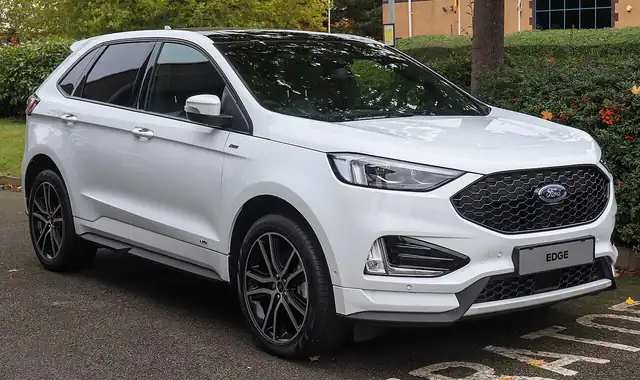
Ford Edge reliability by year
Each year is complaints filed in that year’s first 3 years on the road, divided by however many of those years have passed. A model year younger than 3 years is too early to compare, so it is left out of the years named as having the fewest or the most complaints. Recalls are a separate count. The numbers are for the US-market Ford Edge. How we count.
By model year
| Year | Per year on the road | Complaints | Recalls | Most-filed complaint | Avg. combined MPG |
|---|---|---|---|---|---|
| 2024 → | 15 | 44 | 2 | Back-over prevention | 22.3 |
| 2023 → Fewest | 4 | 22 | 4 | Electrical system | 22.3 |
| 2022 → Fewest | 12 | 130 | 5 | Powertrain | 22.3 |
| 2021 → Fewest | 10 | 110 | 7 | Powertrain | 22.8 |
| 2020 → | 14 | 316 | 4 | Powertrain | 22.8 |
| 2019 → | 20 | 765 | 3 | Powertrain | 23 |
| 2018 → | 22 | 817 | 7 | Engine | 21.7 |
| 2017 → | 27 | 1,351 | 8 | Engine | 21.7 |
| 2016 → | 43 | 910 | 7 | Engine | 22 |
| 2015 → | 51 | 726 | 7 | Engine | 21.9 |
| 2014 → | 15 | 382 | 3 | Service brakes | 21.2 |
| 2013 → Most | 146 | 2,444 | 2 | Electrical system | 21 |
| 2012 → | 61 | 1,134 | 3 | Electrical system | 21.2 |
Years with a → link have a full model-year page.
What owners file about
Generations
- Body styles
- SUV
- Oil
- 5W-20 synthetic (3.5L/3.7L V6); 5W-30 synthetic (2.0L EcoBoost) · 6 qt capacity
- Tire size
- 235/65R17 (SE) to 265/40R22 (Sport)
Known issues for this generation
NHTSA recall 14V-393 covered certain 2012-2014 Edge and Lincoln MKX vehicles manufactured September 2, 2010 to November 30, 2013, along with several other Ford and Lincoln models, for a halfshaft retention circlip that may not have been properly installed; the halfshaft could then move outward and disengage from the linkshaft while driving and without prior warning. Power would no longer be transmitted to the wheels, and if the parking brake was not applied before exiting, the vehicle could roll away despite the transmission being in Park. Dealers inspected the vehicle to confirm the halfshaft was properly retained and, where it was not, replaced the linkshaft and also the halfshaft if it showed spline damage, free of charge.
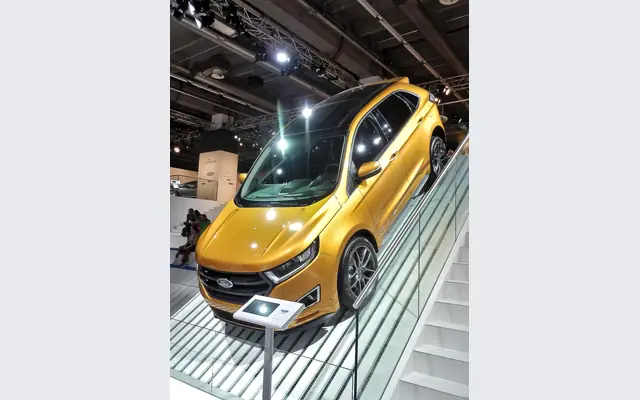

- Body styles
- SUV
- Oil
- 5W-30 synthetic (2.0L/2.7L EcoBoost); 5W-20 synthetic (3.5L V6) · 6 qt capacity
- Tire size
- 235/60R18 (SE) to 255/45R20 (Sport)
Known issues for this generation
NHTSA recall 17V-427 covered 2017 Edge vehicles, along with the 2017 Ford Fusion and Lincoln MKZ, built with 2.0L gas engines and six-speed automatic transmissions whose torque converter weld studs may have been inadequately welded. If the weld studs fail, the torque converter is no longer connected to the engine flexplate and the vehicle loses the ability to move. Dealers replaced the torque converter free of charge; the campaign covered 6,026 vehicles across the three models.

- Body styles
- SUV
- Oil
- 5W-30 synthetic blend (2.0L EcoBoost and 2.7L EcoBoost ST) · 5.7 qt capacity
- Tire size
- 235/60R18 (SE) to 245/50R20 (ST)
Known issues for this generation
NHTSA recall 25V442 covers 2019-2020 Edge vehicles, among roughly 200,000 Ford and Lincoln vehicles across twenty nameplates, for a software error that may cause the rearview camera to display a blank image or leave the image on the display after the backing event has ended. A blank image can reduce the driver's view behind the vehicle, and an image that stays up after the vehicle is shifted out of reverse may distract the driver. Dealers update the rearview camera software free of charge.
Frequently asked questions
Which Ford Edge years have fewer owner complaints?
Among years old enough to compare, the fewest complaints per year are 2023 at 4 (from 22 complaints), 2021 at 10 (from 110 complaints), and 2022 at 12 (from 130 complaints).
Which Ford Edge year has the most owner complaints?
2013 has the most complaints per year, at 146 (2,444 complaints). On the 2013 Ford Edge, 463 of 2,444 complaints name Electrical system.
How do Ford Edge owner complaints compare by year?
Newer Ford Edge years have fewer owner complaints per year than the older ones. From 2018 on, complaints per year fall.
What generation is my Ford Edge?
2011-2014 is the 1st-generation facelift, 2015-2018 is the 2nd generation, and 2019-2024 is the 2nd-generation facelift; Ford discontinued the Edge after the 2024 model year.
Is the Ford Edge still in production?
No. Ford ended Edge production in 2024 and this catalog does not track model years after 2024 for this model.
Was the Ford Edge recalled for a torque converter problem?
Yes. NHTSA recall 17V-427 covered 2017 Edge vehicles with the 2.0L gas engine and six-speed automatic whose torque converter weld studs may have been inadequately welded, which can leave the vehicle unable to move.