
2022 Honda Pilot reliability

Is it reliable?

NHTSA's file on the 2022 Honda Pilot holds 154 complaints after 5 years, a rate of 20 per year. That is fewer complaints per year than most Pilot years here — under the median of the other years, which is 36. NHTSA has 5 recalls on file, including Frame, Front passenger seat weight sensor, and Brake master cylinder.

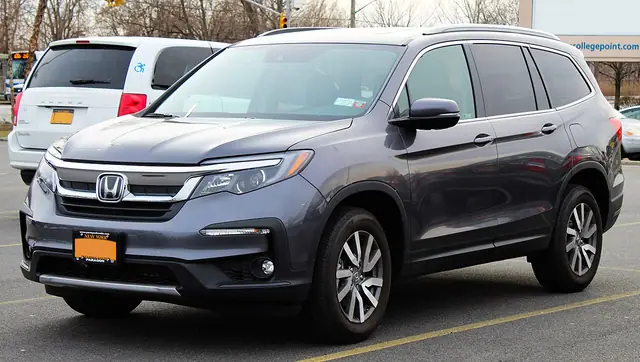
2019 Honda Pilot EX-L
Photo by Kevauto, resized from the original. Wikimedia Commons CC BY-SA 4.0
Complaints

154

Per year

20

Recalls

5

Years on the road

5

What owners report

The complaints owners file most often name Forward collision avoidance (41 of 154), then Electrical system (34) and Engine (28). Complaints that include an odometer have a median of 32,000 miles, and the middle half falls between 19,250 and 56,900 miles. Those filings include 7 that report a crash and 4 that report an injury.

Next to 2021 and 2023

The 2021 Pilot has 432 complaints, 47 per year, and the 2023 has 140 complaints, 29 per year. The 2022 has fewer complaints per year than the 2021. The 2022 has fewer complaints per year than the 2023.

The complaint rate is complaints filed in this year’s first 3 years on the road, divided by however many of those years have passed. Recalls are a separate count. The numbers are for the US-market 2022 Honda Pilot. How we count. Data as of .

Recalls (5)

Recall structure, frame 2026-06-04 · NHTSA campaign 26V365000
Summary American Honda Motor Company (Honda) is recalling certain 2016-2022 Honda Pilot, 2017-2023 Ridgeline, 2019-2023 Passport, and 2014-2020 Acura MDX vehicles that were sold in Connecticut, Delaware, District of Columbia, Illinois, Indiana, Iowa, Kentucky, Maine, Maryland, Massachusetts, Michigan, Minnesota, Missouri, New Hampshire, New Jersey, New York, Ohio, Pennsylvania, Rhode Island, Vermont, Virginia, West Virginia, or Wisconsin. The rear subframe may corrode at the suspension mounting points, which can result in rear suspension component failure.
Remedy Dealers will inspect the rear subframe and install a rear subframe reinforcement kit and, as necessary, repair or replace the rear subframe components, free of charge. Interim letters notifying owners of the safety risk were mailed July 27, 2026. Additional letters will be sent once the final remedy is available, anticipated in the fall of 2026. Owners may contact Honda's customer service at 1-888-234-2138. Honda's numbers for this recall are AOU and AOT. Vehicle Identification Numbers (VINs) involved in this recall will become searchable on NHTSA.gov beginning June 10, 2026.
Vehicles affected 880,514
Recall Front passenger seat weight sensor 2026-05-21 · NHTSA campaign 26V332000
Summary Honda (American Honda Motor Co.) is recalling certain 2018-2021, 2023 Acura TLX, 2019-2024 RDX, 2017-2020, 2022-2026 MDX, 2017-2021, 2023, 2025 Honda Ridgeline, 2017-2022 Pilot, 2019-2021 Passport, 2018-2026 Odyssey, 2019-2022 Insight, 2019-2021 HR-V, 2018-2020 Fit, 2020-2022 CR-V Hybrid, 2017-2022 CR-V, 2017-2018, 2021 Civic Type R, 2017-2021 Civic hatchback, 2016-2020 Civic coupe, 2016-2022 Civic, 2017-2022 Accord Hybrid, and 2016-2022 Accord vehicles. The front passenger seat weight sensor may crack and short circuit, which can cause the air bags to deploy unintentionally during a crash.
Remedy Dealers will replace the seat weight sensors, free of charge. Owner notification letters were mailed July 7, 2026. Owners may contact Honda's customer service at 1-888-234-2138. Honda's numbers for this recall are BOL, WO9, OOA, WOM, XOH, NOC, POD, BOE, UOF, POB, EOG, AOI, QO8, TOJ, DO7, and SOK. This recall expands previous NHTSA recall number 24V064. Vehicle Identification Numbers (VINs) involved in this recall will be searchable on NHTSA.gov beginning May 29, 2026.
Vehicles affected 98,892
Recall Front passenger seat weight sensor 2024-02-01 · NHTSA campaign 24V064000
Summary Honda (American Honda Motor Co.) is recalling certain 2020-2022 Pilot, Accord, Civic sedan, HR-V, Odyssey, 2020 Civic coupe, Fit, 2021-2022 Civic hatchback, 2021 Civic Type R, Insight, 2020-2021 CR-V, CR-V Hybrid, Passport, Ridgeline, Accord Hybrid, 2020 Acura MDX, 2022 Acura MDX, 2020-2022 Acura RDX, and 2020-2021 Acura TLX vehicles. The front passenger seat weight sensor may crack and short circuit, failing to suppress the air bag as intended.
Remedy Dealers will replace the seat weight sensors, free of charge. Owner notification letters were mailed March 28, 2024. This is a phased recall. Owners may contact Honda customer service at 1-888-234-2138. Honda's numbers for these recalls are XHP and VHQ.
Vehicles affected 750,114
Recall Brake master cylinder 2023-06-29 · NHTSA campaign 23V458000
Summary Honda (American Honda Motor Co.) is recalling certain 2020-2021 Civic, 2020-2023 Ridgeline, 2021-2023 Passport, 2021-2022 Pilot, and 2020 Acura MDX vehicles. The tie rod fastener that connects the brake booster and the brake master cylinder may have been improperly assembled during manufacturing, which can cause the brake master cylinder to separate from the booster assembly.
Remedy Dealers will inspect and repair the brake booster assembly as necessary, free of charge. Owner notification letters were mailed August 7, 2023. Owners may contact Honda customer service at 1-888-234-2138. Honda's numbers for this recall are VEU, AEV, and ZET.
Vehicles affected 124,077
Recall back-over prevention, display 2023-06-15 · NHTSA campaign 23V431000
Summary Honda (American Honda Motor Co.) is recalling certain 2018-2023 Odyssey, 2019-2022 Pilot, and 2019-2023 Passport vehicles. Due to a faulty Media Oriented Systems Transport (MOST) communication coaxial cable connector, the rearview camera image may not appear on the display. As such, these vehicles fail to comply with the requirements of Federal Motor Vehicle Safety Standard number 111, "Rear Visibility."
Remedy Dealers will replace the MOST cable harness and install a straightening cover over the vehicle cable connector, free of charge. Owner notification letters were mailed July 24, 2023. Owners may contact Honda customer service at 1-888-234-2138. Honda's numbers for this recall are EEL, ZEM, and SFC.
Vehicles affected 1,209,673

NHTSA's count is every vehicle in that campaign. A campaign can cover other model years and other models.

Complaints by component (154 total)

Forward collision avoidance
41
Electrical system
34
Engine
28
Lane departure
17
Service brakes
17
Powertrain
14
Speed control
10
Fuel and propulsion system
8
Steering
7
Structure
7
Back-over prevention
6
Suspension
6
Air bags
3
Hydraulic brakes
3
Tires
3
Visibility and wipers
3
Engine and engine cooling
1
Equipment
1
Fuel system, gasoline
1
Visibility
1
Wheels
1
Show 13 more Show less
Crash-flagged

7

Fire-flagged

0

Injury reports

4

Death reports

0

Of the 14 complaints that include an odometer reading, the median is 32,000 miles. The middle half fall between 19,250 and 56,900 miles.

Complaints filed per year

122022182023312024372025562026
Excerpts from recent NHTSA complaint filings
  • "I was driving and the Idle Start Stop was ON and when stopped, the Idle stop system turn OFF my vehicule it went to NEUTRAL when I took my foot out of the pedal the car didn’t want to turn ON again and I was in the…"
    Electrical system, Unknown or other · filed 2026-09-19
  • "My 2022 Honda Pilot began experiencing this problem in approximately November 2025. Since then, the vehicle has repeatedly displayed multiple safety-system warnings simultaneously, including Adaptive Cruise Control…"
    Forward collision avoidance, Lane departure · filed 2026-09-17
  • "Engine fails to restart after stopping at stop lights or stop signs when AUTO START STOP feature is engaged. My safety as well as others pasenger was drivers safety was at risk since incidents occured on busy exit ramps…"
    Engine · filed 2026-09-15
  • "THE UNIT WAS PURCHASED IN JUNE 2022. ALL CARE MAINTENANCE COMPLETED BY AN AUTHORIZED HONDA DEALER. BROUGHT TO HONDA OF [XXX] ON XXX DUE TO CAMERA ELECTRONIC FAILURE. UNIT HAS 34, 162 MILES LOG IN. DTC U3000-49: system…"
    Forward collision avoidance, Lane departure · filed 2026-09-14
  • "The contact owns a 2022 Honda Pilot. The contact stated that while driving 56 MPH, the sunroof exploded without impact. There were no other vehicles nearby. The sunroof visor was closed. The dealer was contacted, and a…"
    Visibility · filed 2026-09-11

NHTSA crash ratings

Version Overall Front Side Rollover
2022 Honda PILOT SUV AWD 5 stars 4 stars 5 stars 4 stars
2022 Honda PILOT SUV FWD 5 stars 4 stars 5 stars 4 stars

Stars are how this vehicle did in NHTSA crash tests. They are a safety result, separate from the complaint record. Not rated means that test was not run for this version.

Fuel economy

Trim Engine Transmission Drive City Hwy Combined Annual fuel cost
Pilot all-wheel drive 3.5L, 6-cyl Automatic (9-speed) All-wheel drive 19 26 22 MPG $2950
Pilot all-wheel drive TrailSport 3.5L, 6-cyl Automatic (9-speed) All-wheel drive 19 25 21 MPG $3100
Pilot front-wheel drive 3.5L, 6-cyl Automatic (9-speed) Front-wheel drive 20 27 23 MPG $2800

Specs and fitment

3rd generation, 2016–2022
Body styles SUV
Oil 0W-20 , 5.7 qt capacity
Tire size 245/60R18 (LX/EX/EX-L) to 245/50R20 (Touring/Elite)
Towing capacity 5,000 lbs

Known issues for this generation

Honda service bulletin 20-029 covers 2016-2019 Pilot Touring and Elite models, plus a VIN range of 2020 Touring and Elite models, for intermittent harsh or jerky upshifts with steady acceleration. Honda traced the symptom to abnormal adaptation values in the transmission control module's software rather than to a mechanical fault; the remedy updates the transmission control module, after which the transmission needs about 500 miles of normal driving to re-adapt to the driver's pattern, and 2016 models additionally require a powertrain control module idle learn. A separate earlier bulletin, 16-008, covers 2016 Pilots with the 9-speed automatic for a different set of shift-quality symptoms, including a sensation of surge while braking and slow downshift response at low engine speeds.

Compare

Frequently asked questions

Is the 2022 Honda Pilot reliable?

NHTSA's file on the 2022 Honda Pilot holds 154 complaints after 5 years, a rate of 20 per year. That is fewer complaints per year than most Pilot years here — under the median of the other years, which is 36. NHTSA has 5 recalls on file, including Frame, Front passenger seat weight sensor, and Brake master cylinder.

What are common problems with a 2022 Honda Pilot?

The complaints owners file most often name Forward collision avoidance (41 of 154), then Electrical system (34) and Engine (28). Complaints that include an odometer have a median of 32,000 miles, and the middle half falls between 19,250 and 56,900 miles. Those filings include 7 that report a crash and 4 that report an injury.

Is the 2022 Honda Pilot more reliable than the years next to it?

The 2021 Pilot has 432 complaints, 47 per year, and the 2023 has 140 complaints, 29 per year. The 2022 has fewer complaints per year than the 2021. The 2022 has fewer complaints per year than the 2023.

Has the 2022 Honda Pilot been recalled?

The 2022 Honda Pilot has 5 recalls on file with NHTSA. See the recalls table on this page for dates, components, and remedies.

How many complaints have owners filed about the 2022 Honda Pilot?

Owners have filed 154 complaints about the 2022 Honda Pilot with NHTSA.

What mpg does a 2022 Honda Pilot get?

EPA-rated combined fuel economy for the 2022 Honda Pilot is 22 MPG. See the fuel economy table on this page for city and highway figures by engine and transmission.

What oil does a Honda Pilot take?

2nd gen: 5W-20 (2009-2012) or 0W-20 (2013-2015). 3rd and 4th gen US Pilots use 0W-20 (about 5.7-5.8 qt with filter on recent fills).

Does recall 24V-900 cover the Honda Pilot?

Certain 2023-2025 Pilots are covered for the fuel tank fill pipe: an incomplete connection may allow a fuel leak; dealers inspect and repair the fill-pipe connection.

What generation is the 2020 Honda Pilot?

3rd generation (2016-2022). The 4th generation starts in 2023.