2015 Honda Pilot reliability

Is it reliable?

Owners have filed 109 complaints with NHTSA about the 2015 Honda Pilot over 12 years — 9 per year. That is the fewest complaints per year among the 13 Pilot years on this site. NHTSA has 4 recalls on file, including Fuel pump and Inflator.

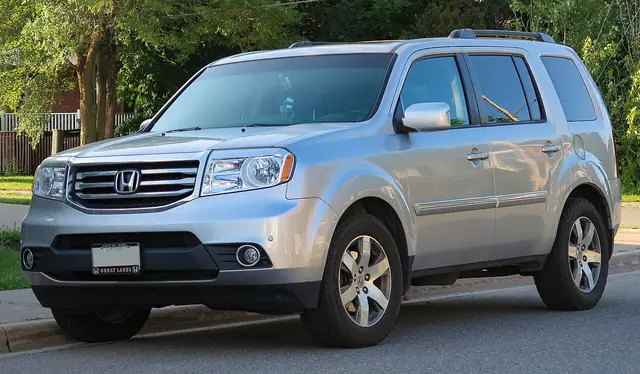
2014 Honda Pilot Touring
Photo by Elise240SX, resized from the original. Wikimedia Commons CC BY-SA 4.0
Complaints

109

Per year

9

Recalls

4

Years on the road

12

What owners report

The complaints owners file most often name Engine (22 of 109), then Electrical system (13) and Service brakes (12). Complaints that include an odometer have a median of 46,000 miles, and the middle half falls between 21,500 and 78,500 miles. Those filings include 7 that report a crash, 1 that reports a fire, and 3 that report an injury.

Next to 2014 and 2016

The 2014 Pilot has 116 complaints, 13 per year, and the 2016 has 1,701 complaints, 62 per year. The 2015 has fewer complaints per year than the 2014. The 2015 has fewer complaints per year than the 2016.

The complaint rate is complaints filed in this year’s first 3 years on the road, divided by however many of those years have passed. Recalls are a separate count. The numbers are for the US-market 2015 Honda Pilot. How we count. Data as of .

Recalls (4)

Recall Fuel pump 2023-12-18 · NHTSA campaign 23V858000
Summary Honda (American Honda Motor Co.) is recalling certain 2013-2023 Honda Accord, Civic Coupe, Civic Sedan, Civic Hatchback, Civic Type R, CR-V, HR-V, Ridgeline, Odyssey, Acura ILX, MDX, MDX Hybrid, RDX, RLX, TLX, 2019-2022 Honda Insight, Passport, 2020 Honda CR-V Hybrid, 2018-2019 Honda Clarity PHEV, Fit, and 2015-2020 Honda Accord Hybrid, Pilot, Acura NSX vehicles. The fuel pump inside the fuel tank may fail.
Remedy Dealers will replace the fuel pump module, free of charge. Owner letters were mailed September 6, 2024. Owners may contact Honda customer service at 1-888-234-2138. Honda's numbers for this recall are KGC and KGD. This recall is an expansion of NHTSA recall numbers 21V-215 and 20V-314.
Vehicles affected 2,490,460
Recall air bags, frontal, passenger side, inflator 2019-06-27 · NHTSA campaign 19V502000
Summary Honda (American Honda Motor Co.) is recalling certain 2009-2014 Acura TSX, 2011-2014 TSX Sport Wagon, 2010-2013 ZDX, 2008-2012 Honda Accord, 2010-2011 Accord Crosstour, 2006-2011 Civic and Civic Hybrid, 2008-2010 Civic GX NGV, 2012-2015 Crosstour, 2007-2011 CR-V, 2009-2013 Fit, 2014 Fit EV, 2010-2014 Insight, and 2009-2015 Pilot vehicles. The vehicles are equipped with passenger frontal air bag inflators assembled as a recall remedy part or replacement service part, that may explode due to propellant degradation occurring after long-term exposure to high absolute humidity, temperature and temperature cycling.
Remedy Honda will notify owners, and dealers will replace the passenger frontal air bag inflator, free of charge. The recall began August 12, 2019. Owners may contact Honda customer service at 1-888-234-2138. Honda's numbers for this recall are F5F and Q5E.
Vehicles affected 9,555
Recall air bags, frontal, passenger side, inflator 2019-05-16 · NHTSA campaign 19V378000
Summary Honda (American Honda Motor Co.) is recalling certain 2009-2014 Acura TSX, 2011-2013 TSX Sport Wagon, and 2010-2012 ZDX and 2008-2012 Honda Accord, 2010-2011 Accord Crosstour, 2006-2011 Civic, Civic Hybrid and Civic NGV, 2012-2014 Crosstour, 2007-2011 CR-V, 2009-2013 Fit, 2010-2013 Insight, and 2009-2015 Pilot vehicles. The front passenger air bag inflator may have been installed incorrectly during replacement.
Remedy Honda will notify owners, and dealers will inspect the inflator installation and, if necessary, replace the passenger frontal air bag module assembly, free of charge. The recall began July 5, 2019. Owners may contact Honda customer service at 1-888-234-2138. Honda's numbers for this recall are M4O, P4R, T4Q, and W4P.
Vehicles affected 19,138
Recall air bags, frontal, passenger side, inflator 2018-09-27 · NHTSA campaign 18V661000
Summary Honda (American Honda Motor Co.) is recalling certain 2014 Honda Insight and Acura TSX and TSX Wagon, 2014-2015 Honda Crosstour and Pilot vehicles nationwide, as well as certain 2014 Honda FCX Clarity and Fit EV vehicles in Florida, Hawaii, Puerto Rico, Texas, Alabama, Georgia, Louisiana, Mississippi, South Carolina, California, American Samoa, Guam, the Northern Mariana Islands (Saipan) and the U.S. Virgin Islands. Honda is also recalling certain 2011-2013 Acura TSX, TSX Wagon and ZDX, Honda Crosstour, Insight, Fit and Pilot vehicles, 2011-2012 Honda Accord and 2011 Honda Civic NGV, Civic, Civic Hybrid and CR-V vehicles in Arizona, Arkansas, Delaware, the District of Columbia, Illinois, Indiana, Kansas, Kentucky, Maryland, Missouri, Nebraska, Nevada, New Jersey, New Mexico, North Carolina, Ohio, Oklahoma, Pennsylvania, Tennessee, Virginia and West Virginia. Lastly, Honda is recalling certain 2010-2013 Acura TSX and ZDX, Honda Crosstour, Fit, Insight and Pilot, 2011-2013 TSX Wagon, 2010-2012 Honda Accord and 2010-2011 Honda Civic NGV, Civic, Civic Hybrid and CR-V vehicles in Alaska, Colorado, Connecticut, Idaho, Iowa, Maine, Massachusetts, Michigan, Minnesota, Montana, New Hampshire, New York, North Dakota, Oregon, Rhode Island, South Dakota, Utah, Vermont, Washington, Wisconsin and Wyoming. These vehicles are equipped with certain air bag air bag inflators assembled as part of the frontal air bag modules, and used as original equipment or replacement equipment (such as after a vehicle crash necessitating replacement of the original air bags), may explode due to propellant degradation occurring after long-term exposure to higher absolute humidity, temperature and temperature cycling.
Remedy Honda will notify owners, and dealers will replace the passenger frontal air bag inflator, free of charge. The recall began November 6, 2018. Owners may contact Honda customer service at 1-888-234-2138. Honda's numbers for this recall are M2J and S2K.
Vehicles affected 1,355,406

NHTSA's count is every vehicle in that campaign. A campaign can cover other model years and other models.

Complaints by component (109 total)

Engine
22
Electrical system
13
Service brakes
12
Air bags
11
Powertrain
11
Structure
10
Suspension
7
Fuel and propulsion system
6
Visibility and wipers
6
Exterior lighting
4
Equipment
3
Speed control
3
Steering
3
Engine and engine cooling
2
Seat belts
2
Seats
2
Back-over prevention
1
Lane departure
1
Tires
1
Visibility
1
Show 12 more Show less
Crash-flagged

7

Fire-flagged

1

Injury reports

3

Death reports

0

Of the 64 complaints that include an odometer reading, the median is 46,000 miles. The middle half fall between 21,500 and 78,500 miles.

Complaints filed per year

12014122015102016520178201815201910202082021520227202311202410202572026
Excerpts from recent NHTSA complaint filings
  • "On September 13, 2026, I was cleaning my 2015 Honda Pilot at a car wash while my young child was inside the vehicle. My keys and phone were also inside. After I closed the front passenger-side door, the vehicle…"
    Structure · filed 2026-09-14
  • "On July 3, 2026 the check engine light, check VSA warning and check emissions warning indicators all illuminated simultaneously and the vehicle began to misfire and sputter which triggered an immediate slow down of…"
    Engine · filed 2026-07-29
  • "The contact owns a 2015 Honda Pilot. The contact stated that upon pulling into the gas station and parking the vehicle, the vehicle made an abnormally loud sound, and the contact also noticed a grinding sound coming…"
    Suspension · filed 2026-06-10
  • "1. The engine assembly failed — Piston 1 suffered catastrophic failure due to VCM-related piston ring wear and oil sludge buildup, generating DTCs P0301–P0304 (engine misfire, cylinders 1–4). Vehicle is completely…"
    Powertrain · filed 2026-05-11
  • "While driving in traffic the vehicle suddenly began to sputter and lose power with check engine light flashing on the dash board. I was able to pull over and limp the car the one mile to my home on side streets. I…"
    Engine · filed 2026-03-12

NHTSA crash ratings

Version Overall Front Side Rollover
2015 Honda Pilot SUV 4WD 4 stars 4 stars 5 stars 4 stars
2015 Honda Pilot SUV FWD 4 stars 4 stars 5 stars 4 stars

Stars are how this vehicle did in NHTSA crash tests. They are a safety result, separate from the complaint record. Not rated means that test was not run for this version.

Fuel economy

Trim Engine Transmission Drive City Hwy Combined Annual fuel cost
Pilot two-wheel drive 3.5L, 6-cyl Automatic 5-speed Front-wheel drive 18 25 20 MPG $3250
Pilot four-wheel drive 3.5L, 6-cyl Automatic 5-speed All-wheel drive 17 24 20 MPG $3250

Specs and fitment

2nd generation, 2009–2015
Body styles SUV
Oil 5W-20 (2009-2012) or 0W-20 (2013-2015) , 4.5 qt capacity
Tire size P245/65R17 (all trims)
Towing capacity 4,500 lbs

Known issues for this generation

The 3.5L V6 in certain 2009-2013 Pilots is affected by a documented piston-ring rotation issue: the rings on some cylinders can rotate out of position and align, leading to spark plug fouling and a cylinder misfire (diagnostic codes P0301-P0304) with the check-engine light on. Following a class-action settlement (Soto et al. v. American Honda Motor Co.), Honda extended the powertrain warranty covering this specific misfire repair to 8 years with unlimited mileage from the original purchase date, and the repair procedure ranges from a spark plug replacement to cleaning the pistons and replacing the piston rings, depending on which cylinders are affected.

Compare

Frequently asked questions

Is the 2015 Honda Pilot reliable?

Owners have filed 109 complaints with NHTSA about the 2015 Honda Pilot over 12 years — 9 per year. That is the fewest complaints per year among the 13 Pilot years on this site. NHTSA has 4 recalls on file, including Fuel pump and Inflator.

What are common problems with a 2015 Honda Pilot?

The complaints owners file most often name Engine (22 of 109), then Electrical system (13) and Service brakes (12). Complaints that include an odometer have a median of 46,000 miles, and the middle half falls between 21,500 and 78,500 miles. Those filings include 7 that report a crash, 1 that reports a fire, and 3 that report an injury.

Is the 2015 Honda Pilot more reliable than the years next to it?

The 2014 Pilot has 116 complaints, 13 per year, and the 2016 has 1,701 complaints, 62 per year. The 2015 has fewer complaints per year than the 2014. The 2015 has fewer complaints per year than the 2016.

Has the 2015 Honda Pilot been recalled?

The 2015 Honda Pilot has 4 recalls on file with NHTSA. See the recalls table on this page for dates, components, and remedies.

How many complaints have owners filed about the 2015 Honda Pilot?

Owners have filed 109 complaints about the 2015 Honda Pilot with NHTSA.

What mpg does a 2015 Honda Pilot get?

EPA-rated combined fuel economy for the 2015 Honda Pilot is 20 MPG. See the fuel economy table on this page for city and highway figures by engine and transmission.

What oil does a Honda Pilot take?

2nd gen: 5W-20 (2009-2012) or 0W-20 (2013-2015). 3rd and 4th gen US Pilots use 0W-20 (about 5.7-5.8 qt with filter on recent fills).

Does recall 24V-900 cover the Honda Pilot?

Certain 2023-2025 Pilots are covered for the fuel tank fill pipe: an incomplete connection may allow a fuel leak; dealers inspect and repair the fill-pipe connection.

What generation is the 2020 Honda Pilot?

3rd generation (2016-2022). The 4th generation starts in 2023.