
Honda CR-V years to avoid and best years
Newer Honda CR-V years have about the same owner complaints per year as the older ones. 2017 has the most complaints per year, at 278 (1,766 complaints). Among years old enough to compare, the fewest complaints per year are 2021 at 27 (from 330 complaints), 2012 at 33 (from 403 complaints), and 2020 at 33 (from 355 complaints). The Honda CR-V 2025 and 2026 model years are too early to compare: none has had 3 full years on the road yet. On the 2017 Honda CR-V, 240 of 1,766 complaints name Engine.
Data as of .
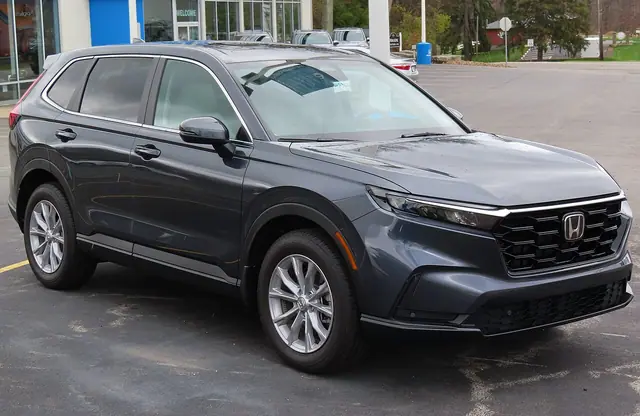
2021
2012
2020
2025–26
Honda CR-V reliability by year
Each year is complaints filed in that year’s first 3 years on the road, divided by however many of those years have passed. A model year younger than 3 years is too early to compare, so it is left out of the years named as having the fewest or the most complaints. Recalls are a separate count. The numbers are for the US-market Honda CR-V. How we count.
By model year
| Year | Per year on the road | Complaints | Recalls | Most-filed complaint | Avg. combined MPG |
|---|---|---|---|---|---|
| 2026 → Too early | 136 | 136 | 0 | Visibility and wipers | 35 |
| 2025 → Too early | 124 | 247 | 1 | Steering | 34.8 |
| 2024 → | 130 | 390 | 2 | Steering | 34 |
| 2023 → | 155 | 515 | 3 | Steering | 34 |
| 2022 → | 36 | 256 | 3 | Steering | 32.3 |
| 2021 → Fewest | 27 | 330 | 4 | Steering | 32.3 |
| 2020 → Fewest | 33 | 355 | 7 | Forward collision avoidance | 32.3 |
| 2019 → | 99 | 1,098 | 8 | Forward collision avoidance | 28.5 |
| 2018 → | 232 | 2,138 | 5 | Steering | 28.5 |
| 2017 → Most | 278 | 1,766 | 7 | Engine | 28.5 |
| 2016 → | 45 | 392 | 3 | Electrical system | 28 |
| 2015 → | 135 | 670 | 3 | Engine | 28.5 |
| 2014 → | 83 | 587 | 1 | Engine | 25.5 |
| 2013 → | 45 | 382 | 2 | Powertrain | 25.5 |
| 2012 → Fewest | 33 | 403 | 3 | Engine | 25.5 |
Years with a → link have a full model-year page.
What owners file about
Generations
- Body styles
- SUV
- Oil
- 5W-20 or 0W-20 · 4.4 qt capacity
- Tire size
- 215/70R16 (LX) to 225/60R18 (Touring)
Known issues for this generation
Certain 2013-2016 CR-Vs were included in a 2023 nationwide safety recall (NHTSA campaign 23V-858) after some units received a replacement fuel pump module with a defective impeller. The impeller can swell and seize, stopping the fuel pump and causing a stall or loss of motive power while driving. Dealers replace the affected fuel pump module set at no cost; the recall does not apply to the 2012 model year, the first year of this generation.
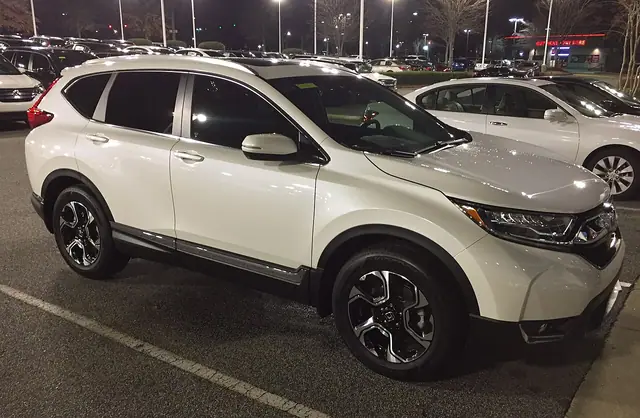

- Body styles
- SUV
- Oil
- 0W-20 · 3.7 qt capacity
- Tire size
- 235/65R17 (LX) to 235/55R19 (Touring)
Known issues for this generation
Certain 2017-2018 CR-Vs with the 1.5L turbocharged engine can develop engine oil dilution on short, cold-weather trips, which can trigger a rough idle or a misfire (diagnostic codes P0300-P0304) or a too-rich fuel-system code (P0172). Honda's fix, described in Service Bulletins 18-114 and 18-124, is a PGM-FI and TCU software update together with an oil change and a driveability relearn procedure; the bulletins name Maine, Minnesota, North Dakota, South Dakota, and Wisconsin as the cold-weather states covered.

- Body styles
- SUV
- Oil
- 0W-20 · 4.2 qt capacity
- Tire size
- 235/65R17 (LX) to 235/55R19 (Hybrid Sport Touring)
Known issues for this generation
Certain 2023-2025 CR-V Hybrid vehicles are covered by a nationwide safety recall (NHTSA campaign 24V-763, Honda number PJW) for a high-pressure fuel pump that may have been manufactured improperly, allowing a crack to form and develop a fuel leak. Honda states a fuel leak in the presence of an ignition source increases fire risk; dealers inspect the pump and replace it when a leak is confirmed. The recall does not apply to the gasoline-only 1.5L turbo CR-V.
Frequently asked questions
Which Honda CR-V years have fewer owner complaints?
Among years old enough to compare, the fewest complaints per year are 2021 at 27 (from 330 complaints), 2012 at 33 (from 403 complaints), and 2020 at 33 (from 355 complaints).
Which Honda CR-V year has the most owner complaints?
2017 has the most complaints per year, at 278 (1,766 complaints). On the 2017 Honda CR-V, 240 of 1,766 complaints name Engine.
How do Honda CR-V owner complaints compare by year?
Newer Honda CR-V years have about the same owner complaints per year as the older ones.
Which Honda CR-V years are too early to compare?
The Honda CR-V 2025 and 2026 model years are too early to compare: none has had 3 full years on the road yet.
What generation is the 2020 Honda CR-V?
5th generation (2017-2022).
Does the Honda CR-V have oil dilution problems?
The 1.5L turbo engine in 2017-2018 CR-Vs is affected by a documented fuel-dilution issue on short, cold trips; Honda issued a software and oil-change fix but did not issue a recall.