
Honda Accord years to avoid and best years
Newer Honda Accord years have fewer owner complaints per year than the older ones. 2018 has the most complaints per year, at 136 (1,876 complaints). Among years old enough to compare, the fewest complaints per year are 2023 at 16 (from 85 complaints), 2021 at 22 (from 231 complaints), and 2022 at 22 (from 246 complaints). The Honda Accord 2025 and 2026 model years are too early to compare: none has had 3 full years on the road yet. On the 2018 Honda Accord, 248 of 1,876 complaints name Engine.
Data as of .
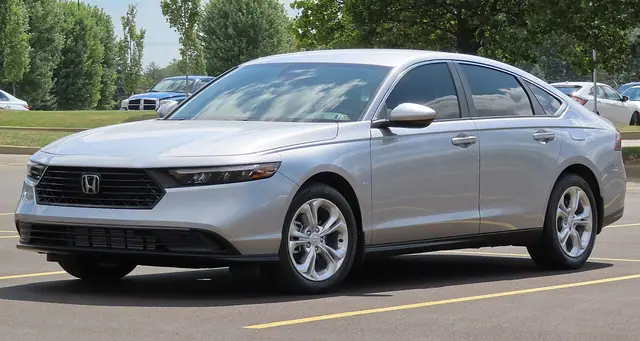
2023
2021
2022
2025–26
Honda Accord reliability by year
Each year is complaints filed in that year’s first 3 years on the road, divided by however many of those years have passed. A model year younger than 3 years is too early to compare, so it is left out of the years named as having the fewest or the most complaints. Recalls are a separate count. The numbers are for the US-market Honda Accord. How we count.
By model year
| Year | Per year on the road | Complaints | Recalls | Most-filed complaint | Avg. combined MPG |
|---|---|---|---|---|---|
| 2026 Too early | 7 | 7 | 0 | Electrical system | 38.8 |
| 2025 → Too early | 42 | 84 | 0 | Steering | 41.3 |
| 2024 → | 47 | 141 | 3 | Steering | 41.3 |
| 2023 → Fewest | 16 | 85 | 5 | Steering | 41.3 |
| 2022 → Fewest | 22 | 246 | 4 | Electrical system | 36.2 |
| 2021 → Fewest | 22 | 231 | 4 | Forward collision avoidance | 36.4 |
| 2020 → | 35 | 359 | 5 | Forward collision avoidance | 31.6 |
| 2019 → | 48 | 688 | 6 | Forward collision avoidance | 31.6 |
| 2018 → Most | 136 | 1,876 | 6 | Engine | 31.4 |
| 2017 → | 53 | 534 | 3 | Electrical system | 29 |
| 2016 → | 67 | 603 | 4 | Exterior lighting | 26 |
| 2015 → | 49 | 601 | 5 | Electrical system | 29 |
| 2014 → | 64 | 980 | 4 | Electrical system | 31.1 |
| 2013 → | 121 | 1,420 | 5 | Steering | 26 |
| 2012 → | 47 | 381 | 8 | Seats | 24.6 |
Years with a → link have a full model-year page.
What owners file about
Generations
- Body styles
- Sedan, Coupe
- Oil
- 5W-20 (2008-2010); 0W-20 (2011-2012) · 4.2 qt capacity
- Tire size
- 205/65R16 (LX) to 235/45R17 (EX/EX-L)
Known issues for this generation
Honda Service Bulletin 12-087 documents sticking oil control rings on the four-cylinder engine in all 2008-2009 Accords and in specific VIN ranges of the 2010-2011 cars. Honda says deposits form on the rings only when three conditions occur together on a regular and prolonged basis - the engine is cold, it is accelerated hard while cold, and the fuel used has an unusually high concentration of particles - and that over years of driving this way the rings can stick and oil consumption can rise. The dealer procedure is an engine oil consumption test followed, if necessary, by replacement of all engine pistons and piston rings; the bulletin states that the normal warranty applies to this repair. A separate bulletin, 13-078, covers 2008-2012 Accords with the V6 automatic, on which piston rings can rotate and align, foul the spark plugs and set misfire codes P0301 through P0304 with the check engine light on. Honda extended the powertrain warranty for that repair to 8 years with unlimited mileage from the original purchase date, following the settlement of Soto et al. v. American Honda Motor Co. (N.D. Cal., No. 3:12-cv-1377-SI). On 2008-2011 cars the first step is a PCM software update and new spark plugs, with piston cleaning and new rings only if the car comes back; 2012 cars go straight to piston cleaning and new rings. The extension does not apply to a car that has ever been declared a total loss, sold for salvage, or given a branded title.
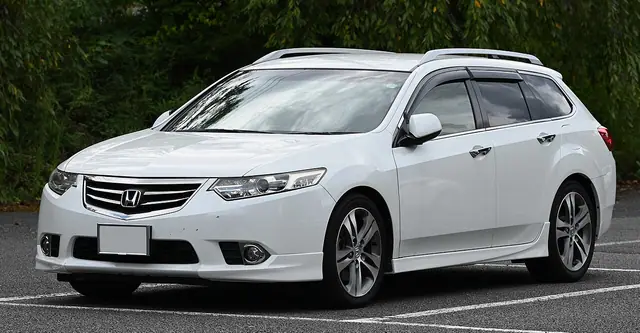

- Body styles
- Sedan, Coupe
- Oil
- 0W-20 · 4.4 qt capacity
- Tire size
- 205/65R16 (LX), 215/55R17 (EX/EX-L), 235/40R19 (Sport/Touring)
Known issues for this generation
2013-2017 Accord V6 models with the 6-speed automatic transmission are affected by a documented judder from the torque converter lock-up clutch, felt while driving between 20 and 60 mph. Honda notes the problem is typically misdiagnosed as a bad torque converter: American Honda investigated and found the torque converter was not causing the judder and that the transmission is not damaged by it. The cause is transmission fluid that deteriorates faster than expected on certain drive cycles. Service Bulletin 17-017 has the dealer confirm the judder from a data snapshot, update the PGM-FI or A/T software, then flush the transmission with Honda ATF DW-1; a companion bulletin, 17-018, covers cars that still deteriorate fluid after the software update. Four-cylinder CVT models are not covered by this bulletin.
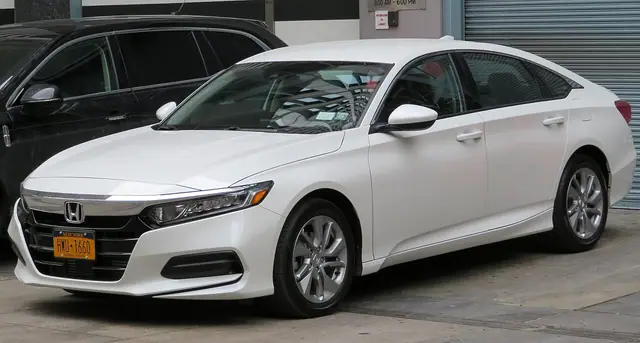

- Body styles
- Sedan
- Oil
- 0W-20 · 3.7 qt capacity
- Tire size
- 225/50R17 (LX/EX/EX-L) to 235/40R19 (Sport/Touring)
Known issues for this generation
Certain 2018-2022 Accords with the 1.5L turbocharged engine are affected by a documented head-gasket defect: coolant can seep through grooves in the cylinder head and degrade the gasket, eventually leaking into the cylinders. This causes engine misfires, a rough-running engine, and reduced coolant that can lead to overheating if unaddressed. The defect is the subject of proposed class-action litigation covering 2018-2022 Accord, 2016-2022 Civic, and 2017-2022 CR-V models with this engine family.

- Body styles
- Sedan
- Oil
- 0W-20 · 3.7 qt capacity
- Tire size
- 225/50R17 (LX/EX/EX-L) to 235/40R19 (Sport/Touring)
Known issues for this generation
Certain 2023-2024 Accords, all trim levels, were included in a safety recall (NHTSA campaign 24V-763, Honda Service Bulletin 24-123) for an improperly manufactured high-pressure fuel pump that can fracture and develop a fuel leak. Honda states a fuel leak in the presence of an ignition source may increase the risk of a fire or injury, and dealers inspect the pump and replace it when it fails the inspection.
Frequently asked questions
Which Honda Accord years have fewer owner complaints?
Among years old enough to compare, the fewest complaints per year are 2023 at 16 (from 85 complaints), 2021 at 22 (from 231 complaints), and 2022 at 22 (from 246 complaints).
Which Honda Accord year has the most owner complaints?
2018 has the most complaints per year, at 136 (1,876 complaints). On the 2018 Honda Accord, 248 of 1,876 complaints name Engine.
How do Honda Accord owner complaints compare by year?
Newer Honda Accord years have fewer owner complaints per year than the older ones.
Which Honda Accord years are too early to compare?
The Honda Accord 2025 and 2026 model years are too early to compare: none has had 3 full years on the road yet.
What generation is the 2020 Honda Accord?
10th generation (2018-2022).
Does the Honda Accord have head gasket or oil dilution problems?
Certain 2018-2022 Accords with the 1.5L turbo engine have a documented head-gasket coolant leak issue; there is no NHTSA recall, but Honda has issued dealer service communications.