
2017 Honda Accord reliability

Is it reliable?

NHTSA's file on the 2017 Honda Accord holds 534 complaints after 10 years, a rate of 53 per year. That is more complaints per year than most Accord years here — over the median of the other years, which is 48. NHTSA has 3 recalls on file, including Front passenger seat weight sensor and Fuel pump.

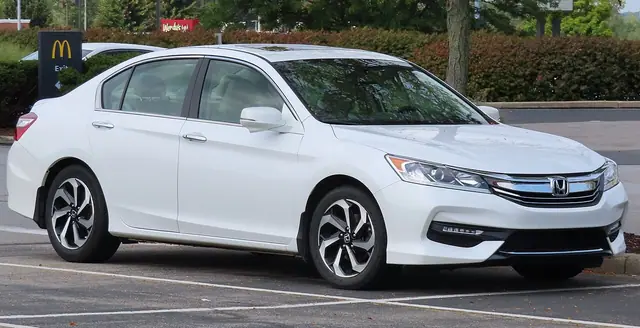
2016 Honda Accord EX-L sedan
Photo by MercurySable99, resized from the original. Wikimedia Commons CC BY-SA 4.0
Complaints

534

Per year

53

Recalls

3

Years on the road

10

What owners report

The complaints owners file most often name Electrical system (152 of 534), then Engine (62) and Fuel and propulsion system (55). Complaints that include an odometer have a median of 25,000 miles, and the middle half falls between 7,000 and 46,500 miles. Those filings include 38 that report a crash, 9 that report a fire, 19 that report an injury, and 2 that report a death.

Next to 2016 and 2018

The 2016 Accord has 603 complaints, 67 per year, and the 2018 has 1,876 complaints, 136 per year. The 2017 has fewer complaints per year than the 2016. The 2017 has fewer complaints per year than the 2018.

The complaint rate is complaints filed in this year’s first 3 years on the road, divided by however many of those years have passed. Recalls are a separate count. The numbers are for the US-market 2017 Honda Accord. How we count. Data as of .

Recalls (3)

Recall Front passenger seat weight sensor 2026-05-21 · NHTSA campaign 26V332000
Summary Honda (American Honda Motor Co.) is recalling certain 2018-2021, 2023 Acura TLX, 2019-2024 RDX, 2017-2020, 2022-2026 MDX, 2017-2021, 2023, 2025 Honda Ridgeline, 2017-2022 Pilot, 2019-2021 Passport, 2018-2026 Odyssey, 2019-2022 Insight, 2019-2021 HR-V, 2018-2020 Fit, 2020-2022 CR-V Hybrid, 2017-2022 CR-V, 2017-2018, 2021 Civic Type R, 2017-2021 Civic hatchback, 2016-2020 Civic coupe, 2016-2022 Civic, 2017-2022 Accord Hybrid, and 2016-2022 Accord vehicles. The front passenger seat weight sensor may crack and short circuit, which can cause the air bags to deploy unintentionally during a crash.
Remedy Dealers will replace the seat weight sensors, free of charge. Owner notification letters were mailed July 7, 2026. Owners may contact Honda's customer service at 1-888-234-2138. Honda's numbers for this recall are BOL, WO9, OOA, WOM, XOH, NOC, POD, BOE, UOF, POB, EOG, AOI, QO8, TOJ, DO7, and SOK. This recall expands previous NHTSA recall number 24V064. Vehicle Identification Numbers (VINs) involved in this recall will be searchable on NHTSA.gov beginning May 29, 2026.
Vehicles affected 98,892
Recall Fuel pump 2023-12-18 · NHTSA campaign 23V858000
Summary Honda (American Honda Motor Co.) is recalling certain 2013-2023 Honda Accord, Civic Coupe, Civic Sedan, Civic Hatchback, Civic Type R, CR-V, HR-V, Ridgeline, Odyssey, Acura ILX, MDX, MDX Hybrid, RDX, RLX, TLX, 2019-2022 Honda Insight, Passport, 2020 Honda CR-V Hybrid, 2018-2019 Honda Clarity PHEV, Fit, and 2015-2020 Honda Accord Hybrid, Pilot, Acura NSX vehicles. The fuel pump inside the fuel tank may fail.
Remedy Dealers will replace the fuel pump module, free of charge. Owner letters were mailed September 6, 2024. Owners may contact Honda customer service at 1-888-234-2138. Honda's numbers for this recall are KGC and KGD. This recall is an expansion of NHTSA recall numbers 21V-215 and 20V-314.
Vehicles affected 2,490,460
Recall other fuel system, delivery, fuel pump 2019-01-29 · NHTSA campaign 19V060000
Summary Honda (American Honda Motor Co.) is recalling certain 2016-2018 Acura MDX, 2015-2019 Acura TLX and 2015-2017 Honda Accord vehicles, equipped with a 3.5L V6 engine. Particulates in fuel may adhere to the internal components of the fuel pump, reducing its performance.
Remedy Honda will notify owners, and dealers will update the fuel injection engine control unit (FI-ECU) software and, if necessary, replace the fuel pump, free of charge. The recall began March 25, 2019. Owners may contact customer service at 1-888-234-2138. Acura's recall number for this recall is P3W. Honda's recall number for this recall is N3X.
Vehicles affected 437,032

NHTSA's count is every vehicle in that campaign. A campaign can cover other model years and other models.

Complaints by component (534 total)

Electrical system
152
Engine
62
Fuel and propulsion system
55
Wheels
43
Service brakes
42
Forward collision avoidance
34
Powertrain
33
Steering
24
Structure
24
Air bags
23
Exterior lighting
21
Speed control
18
Lane departure
17
Back-over prevention
15
Seat belts
12
Visibility and wipers
12
Electronic stability control (ESC)
8
Fuel system, gasoline
6
Seats
6
Tires
6
Fuel system, other
4
Suspension
3
Air brakes
2
Visibility
2
Equipment
1
Latches, locks, and linkages
1
Show 18 more Show less
Crash-flagged

38

Fire-flagged

9

Injury reports

19

Death reports

2

Of the 229 complaints that include an odometer reading, the median is 25,000 miles. The middle half fall between 7,000 and 46,500 miles.

Complaints filed per year

52016462017372018712019472020452021462022612023502024862025402026
Excerpts from recent NHTSA complaint filings
  • "The car radio / infotainment system caused dangerously loud, painful, pulsating static noise to play from all speakers. The noise starts at a lower decibel and gets louder to the point where conversation is impossible.…"
    Electrical system · filed 2026-08-28
  • "Odometer Fraud. The contact purchased a 2017 Honda Accord. The contact discovered that there was a mileage discrepancy after the purchase. The vehicle was an independent dealer sale. At the time of purchase, the vehicle…"
    Electrical system · filed 2026-08-25
  • "Odometer Fraud. The contact purchased a 2017 Honda Accord. It was discovered that there was a mileage discrepancy. The vehicle was a private sale. At the time of the purchase on June 20, 2026, the mileage was 100,000.…"
    Electrical system · filed 2026-08-19
  • "Very loud static across multiple speakers, often independent of radio volume with intermittent static through multiple speakers even when muted or off. I can't hear sirens or emergency vehicles. I can't hear anything…"
    Electrical system, Unknown or other · filed 2026-08-13
  • "Car shuts off at highway speeds and in stop and go traffic like it has a fuel delivery issue. Car sputters and then loses all power. I know there was a previous recall on this vehicle but I’m curious whether it was…"
    Powertrain, Engine, Fuel and propulsion system · filed 2026-07-28

NHTSA crash ratings

Version Overall Front Side Rollover
2017 Honda Accord 2 DR FWD 5 stars 5 stars 5 stars 5 stars
2017 Honda Accord 4 DR FWD 5 stars 4 stars 5 stars 5 stars
2017 Honda Accord Hybrid 4 DR FWD 5 stars 4 stars 5 stars 5 stars

Stars are how this vehicle did in NHTSA crash tests. They are a safety result, separate from the complaint record. Not rated means that test was not run for this version.

Fuel economy

Trim Engine Transmission Drive City Hwy Combined Annual fuel cost
Accord 3.5L, 6-cyl Manual 6-speed Front-wheel drive 18 28 21 MPG $3100
Accord 3.5L, 6-cyl Automatic 6-speed Front-wheel drive 21 33 25 MPG $2600
Accord 3.5L, 6-cyl Automatic (6-speed) Front-wheel drive 21 32 24 MPG $2700
Accord 2.4L, 4-cyl Manual 6-speed Front-wheel drive 23 32 26 MPG $2500
Accord 2.4L, 4-cyl Automatic (variable gear ratios) Front-wheel drive 27 36 30 MPG $2150
Accord 2.4L, 4-cyl Automatic (AV-S7) Front-wheel drive 26 34 29 MPG $2250
Accord hybrid 2L, 4-cyl Automatic (variable gear ratios) Front-wheel drive 49 47 48 MPG $1350

Specs and fitment

9th generation, 2013–2017
Body styles Sedan, Coupe
Oil 0W-20 , 4.4 qt capacity
Tire size 205/65R16 (LX), 215/55R17 (EX/EX-L), 235/40R19 (Sport/Touring)

Known issues for this generation

2013-2017 Accord V6 models with the 6-speed automatic transmission are affected by a documented judder from the torque converter lock-up clutch, felt while driving between 20 and 60 mph. Honda notes the problem is typically misdiagnosed as a bad torque converter: American Honda investigated and found the torque converter was not causing the judder and that the transmission is not damaged by it. The cause is transmission fluid that deteriorates faster than expected on certain drive cycles. Service Bulletin 17-017 has the dealer confirm the judder from a data snapshot, update the PGM-FI or A/T software, then flush the transmission with Honda ATF DW-1; a companion bulletin, 17-018, covers cars that still deteriorate fluid after the software update. Four-cylinder CVT models are not covered by this bulletin.

Compare

Frequently asked questions

Is the 2017 Honda Accord reliable?

NHTSA's file on the 2017 Honda Accord holds 534 complaints after 10 years, a rate of 53 per year. That is more complaints per year than most Accord years here — over the median of the other years, which is 48. NHTSA has 3 recalls on file, including Front passenger seat weight sensor and Fuel pump.

What are common problems with a 2017 Honda Accord?

The complaints owners file most often name Electrical system (152 of 534), then Engine (62) and Fuel and propulsion system (55). Complaints that include an odometer have a median of 25,000 miles, and the middle half falls between 7,000 and 46,500 miles. Those filings include 38 that report a crash, 9 that report a fire, 19 that report an injury, and 2 that report a death.

Is the 2017 Honda Accord more reliable than the years next to it?

The 2016 Accord has 603 complaints, 67 per year, and the 2018 has 1,876 complaints, 136 per year. The 2017 has fewer complaints per year than the 2016. The 2017 has fewer complaints per year than the 2018.

Has the 2017 Honda Accord been recalled?

The 2017 Honda Accord has 3 recalls on file with NHTSA. See the recalls table on this page for dates, components, and remedies.

How many complaints have owners filed about the 2017 Honda Accord?

Owners have filed 534 complaints about the 2017 Honda Accord with NHTSA.

What mpg does a 2017 Honda Accord get?

EPA-rated combined fuel economy for the 2017 Honda Accord is 29 MPG. See the fuel economy table on this page for city and highway figures by engine and transmission.

What generation is the 2020 Honda Accord?

10th generation (2018-2022).

Does the Honda Accord have head gasket or oil dilution problems?

Certain 2018-2022 Accords with the 1.5L turbo engine have a documented head-gasket coolant leak issue; there is no NHTSA recall, but Honda has issued dealer service communications.