
Tesla Model 3 years to avoid and best years
Newer Tesla Model 3 years have more owner complaints per year than the older ones. 2022 has the most complaints per year, at 222 (765 complaints). 2021 through 2023 are in that same range. Among years old enough to compare, the fewest complaints per year are 2017 at 0 (from 26 complaints), 2019 at 44 (from 612 complaints), and 2018 at 52 (from 1,022 complaints). The Tesla Model 3 2025 and 2026 model years are too early to compare: none has had 3 full years on the road yet. On the 2022 Tesla Model 3, 263 of 765 complaints name Forward collision avoidance.
Data as of .
2017
2019
2018
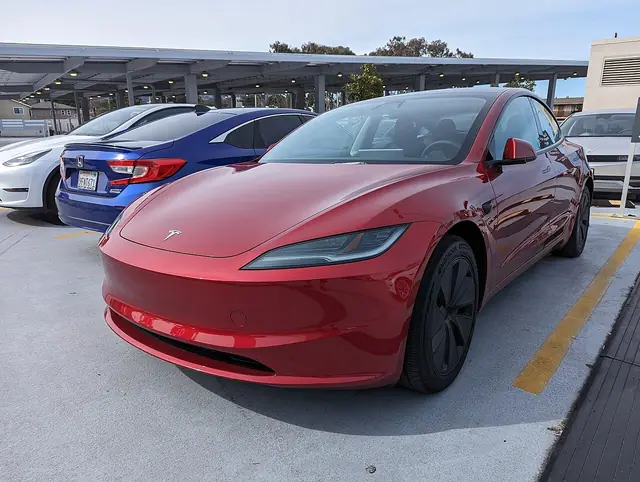
2025–26
Tesla Model 3 reliability by year
Each year is complaints filed in that year’s first 3 years on the road, divided by however many of those years have passed. A model year younger than 3 years is too early to compare, so it is left out of the years named as having the fewest or the most complaints. Recalls are a separate count. The numbers are for the US-market Tesla Model 3. How we count.
By model year
| Year | Per year on the road | Complaints | Recalls | Most-filed complaint | Avg. combined MPG |
|---|---|---|---|---|---|
| 2026 Too early | 0 | 0 | 1 | — | 125.8 |
| 2025 Too early | 0 | 0 | 3 | — | 126.3 |
| 2024 → | 72 | 216 | 5 | Forward collision avoidance | 127.8 |
| 2023 → | 127 | 424 | 12 | Forward collision avoidance | 125.3 |
| 2022 → Most | 222 | 765 | 18 | Forward collision avoidance | 125.3 |
| 2021 → | 168 | 663 | 22 | Forward collision avoidance | 129.7 |
| 2020 → | 62 | 451 | 21 | Forward collision avoidance | 124.5 |
| 2019 → Fewest | 44 | 612 | 22 | Forward collision avoidance | 124.8 |
| 2018 → Fewest | 52 | 1,022 | 19 | Suspension | 121.3 |
| 2017 → Fewest | 0 | 26 | 16 | Air bags, Seat belts, Seats | 126 |
Years with a → link have a full model-year page.
What owners file about
Generations
- Body styles
- Sedan
- Tire size
- 235/45R18 (18-inch), 235/40R19 (19-inch), 235/35R20 (20-inch), 245/35R20 (Performance 20-inch)
Known issues for this generation
Recall 23V-838 covers 2012-2023 Model S, 2016-2023 Model X, 2017-2023 Model 3, and 2020-2023 Model Y vehicles equipped with Autosteer versions up to the remedy software. NHTSA states that in certain circumstances when Autosteer is engaged, the prominence and scope of the feature's controls may not be sufficient to prevent driver misuse of the SAE Level 2 advanced driver-assistance feature, which can increase crash risk if the driver does not remain prepared to intervene. The campaign lists 2,031,220 vehicles across those models; Tesla's remedy is an over-the-air software update. Recall 21V-835 covers certain 2019-2021 Model 3 and 2020-2021 Model Y vehicles whose front suspension lateral link fasteners may loosen and allow the lateral link to separate from the sub-frame; recall 23V-235 expands that fastener issue to certain 2018-2019 Model 3 vehicles. Recall 21V-387 covers certain 2019-2021 Model 3 and 2020-2021 Model Y vehicles whose brake caliper bolts may be loose, allowing the caliper to separate and contact the wheel rim.

- Body styles
- Sedan
- Tire size
- 235/45R18 (18-inch), 235/40R19 (19-inch)
Known issues for this generation
Recall 24V-935 covers certain 2024 Cybertruck, 2017-2025 Model 3, and 2020-2025 Model Y vehicles. NHTSA states the tire pressure monitoring system warning light may not remain illuminated between drive cycles, failing to warn the driver of low tire pressure, so the vehicles fail to comply with FMVSS 138; the campaign lists 696,281 vehicles across those models, and Tesla released an over-the-air software update. Recall 25V-002 covers certain 2024-2025 Model 3, Model S, 2023-2025 Model X, and Model Y vehicles whose computer circuit board may short, resulting in loss of the rearview camera image, so the vehicles fail to comply with FMVSS 111; the campaign lists 239,382 vehicles across those models. Recall 25V-690 covers certain 2025 Model 3 and 2026 Model Y vehicles whose battery pack contactors may fail, causing a loss of drive power; Tesla Service replaces the contactors, and the campaign lists 12,963 vehicles across those two model lines.
Frequently asked questions
Which Tesla Model 3 years have fewer owner complaints?
Among years old enough to compare, the fewest complaints per year are 2017 at 0 (from 26 complaints), 2019 at 44 (from 612 complaints), and 2018 at 52 (from 1,022 complaints).
Which Tesla Model 3 year has the most owner complaints?
2022 has the most complaints per year, at 222 (765 complaints). 2021 through 2023 are in that same range. On the 2022 Tesla Model 3, 263 of 765 complaints name Forward collision avoidance.
How do Tesla Model 3 owner complaints compare by year?
Newer Tesla Model 3 years have more owner complaints per year than the older ones.
Which Tesla Model 3 years are too early to compare?
The Tesla Model 3 2025 and 2026 model years are too early to compare: none has had 3 full years on the road yet.
What generation is the 2020 Tesla Model 3?
First generation (2017-2023), before the Highland refresh.
Does the US Tesla Model 3 have a factory towing rating?
No. The Model 3 is not equipped to tow in the US and Tesla does not publish a US towing capacity for it. A tow package is sold in Europe and some other markets; those ratings are not US ratings.