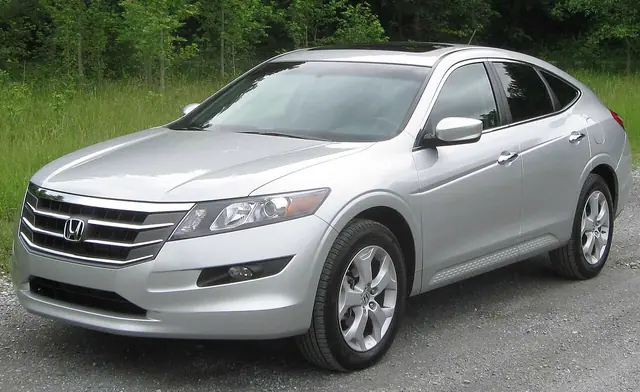
2012 Honda Crosstour reliability
NHTSA's file on the 2012 Honda Crosstour holds 32 complaints after 15 years, a rate of 3 per year. That is more complaints per year than most Crosstour years here — over the median of the other years, which is 2. NHTSA has 4 recalls on file, including Inflator and Side and window.
32
3
4
15
The complaints owners file most often name Powertrain (9 of 32), then Air bags (3) and Electrical system (3). Complaints that include an odometer have a median of 51,000 miles, and the middle half falls between 21,491 and 80,000 miles. Those filings include 2 that report a crash, 1 that reports a fire, and 2 that report an injury.
The 2013 Crosstour has 49 complaints, 4 per year. The 2012 has fewer complaints per year than the 2013.
The complaint rate is complaints filed in this year’s first 3 years on the road, divided by however many of those years have passed. Recalls are a separate count. The numbers are for the US-market 2012 Honda Crosstour. How we count. Data as of .
Recalls (4)
NHTSA's count is every vehicle in that campaign. A campaign can cover other model years and other models.
Complaints by component (32 total)
Show 8 more Show less
2
1
2
0
Of the 19 complaints that include an odometer reading, the median is 51,000 miles. The middle half fall between 21,491 and 80,000 miles.
Complaints filed per year
Excerpts from recent NHTSA complaint filings
-
"An aftermarket ignition interlock device (Intoxalock eLERT model) installed in my vehicle repeatedly malfunctioned and disabled the vehicle’s ignition system, preventing the vehicle from starting and operating normally.…"
-
"An aftermarket ignition interlock device installed in my vehicle requires “rolling retests” while the vehicle is in motion. During these rolling retests, the device alerts the driver and requires a breath sample within…"
-
"Car was due for timing belt maintenance at 100k miles. Timing belt and related parts were changed August 2023. I was told belt will last 100k miles. October 2024, 13.5 months later, the belt fails and causes…"
-
"Fuel pump malfunction"
-
"Honda is aware of faulty VTC actuators on certain models. There is no active recall to repair the defective part. This issue causes extra wear on the engine, which could then lead to catastrophic failure. That causes…"
NHTSA crash ratings
| Version | Overall | Front | Side | Rollover |
|---|---|---|---|---|
| 2012 Honda Crosstour SUV 4WD | Not rated | Not rated | Not rated | 4 stars |
| 2012 Honda Crosstour SUV FWD | Not rated | Not rated | Not rated | 4 stars |
Stars are how this vehicle did in NHTSA crash tests. They are a safety result, separate from the complaint record. Not rated means that test was not run for this version.
Fuel economy
| Trim | Engine | Transmission | Drive | City | Hwy | Combined | Annual fuel cost |
|---|---|---|---|---|---|---|---|
| Crosstour two-wheel drive | 3.5L, 6-cyl | Automatic 5-speed | Front-wheel drive | 18 | 27 | 21 MPG | $3100 |
| Crosstour two-wheel drive | 2.4L, 4-cyl | Automatic 5-speed | Front-wheel drive | 21 | 29 | 24 MPG | $2700 |
| Crosstour four-wheel drive | 3.5L, 6-cyl | Automatic 5-speed | All-wheel drive | 18 | 26 | 21 MPG | $3100 |
Specs and fitment
Known issues for this generation
Honda documented a torque-converter lock-up-clutch judder in two separate campaigns. Service bulletins 16-066 and 16-067 cover the 2010 Accord Crosstour, all trims, for a judder felt between 20 and 45 mph; the remedy is a transmission software update and a transmission fluid replacement, and Honda extended both that update and the torque converter warranty to 8 years or 105,000 miles from the original purchase date, whichever comes first. Service bulletins 17-041 and 17-042 cover 2013-2015 Crosstour V6 automatics for a judder felt between 20 and 60 mph; American Honda investigated and found the torque converter was not the cause and the transmission is not damaged by the judder, which it attributes to transmission fluid that deteriorates faster than expected under intermittent high heat loads. The remedy there is a software update, then a fluid flush if a transmission snapshot still shows the judder. Neither campaign is a safety recall. Honda marketed the vehicle as the "Accord Crosstour" for 2010-2011, then removed the "Accord" prefix for the 2012 model year.
Compare
Frequently asked questions
Is the 2012 Honda Crosstour reliable?
NHTSA's file on the 2012 Honda Crosstour holds 32 complaints after 15 years, a rate of 3 per year. That is more complaints per year than most Crosstour years here — over the median of the other years, which is 2. NHTSA has 4 recalls on file, including Inflator and Side and window.
What are common problems with a 2012 Honda Crosstour?
The complaints owners file most often name Powertrain (9 of 32), then Air bags (3) and Electrical system (3). Complaints that include an odometer have a median of 51,000 miles, and the middle half falls between 21,491 and 80,000 miles. Those filings include 2 that report a crash, 1 that reports a fire, and 2 that report an injury.
Is the 2012 Honda Crosstour more reliable than the years next to it?
The 2013 Crosstour has 49 complaints, 4 per year. The 2012 has fewer complaints per year than the 2013.
Has the 2012 Honda Crosstour been recalled?
The 2012 Honda Crosstour has 4 recalls on file with NHTSA. See the recalls table on this page for dates, components, and remedies.
How many complaints have owners filed about the 2012 Honda Crosstour?
Owners have filed 32 complaints about the 2012 Honda Crosstour with NHTSA.
What mpg does a 2012 Honda Crosstour get?
EPA-rated combined fuel economy for the 2012 Honda Crosstour is 22 MPG. See the fuel economy table on this page for city and highway figures by engine and transmission.
Was the Honda Crosstour called the Accord Crosstour?
Yes — it was the "Accord Crosstour" for 2010-2011, then simply "Crosstour" from 2012 through its final 2015 model year.
Did Honda extend the Crosstour transmission warranty?
For the 2010 Accord Crosstour, Honda extended the torque converter warranty and the judder software update to 8 years or 105,000 miles from the original purchase date, whichever comes first.