
Ford Mustang years to avoid and best years
Newer Ford Mustang years have fewer owner complaints per year than the older ones. 2014 has the most complaints per year, at 73 (359 complaints). From 2018 on, complaints per year fall. Among years old enough to compare, the fewest complaints per year are 2023 at 5 (from 15 complaints), 2021 at 7 (from 55 complaints), and 2022 at 7 (from 49 complaints). The Ford Mustang 2025 and 2026 model years are too early to compare: none has had 3 full years on the road yet. On the 2014 Ford Mustang, 232 of 359 complaints name Air bags.
Data as of .
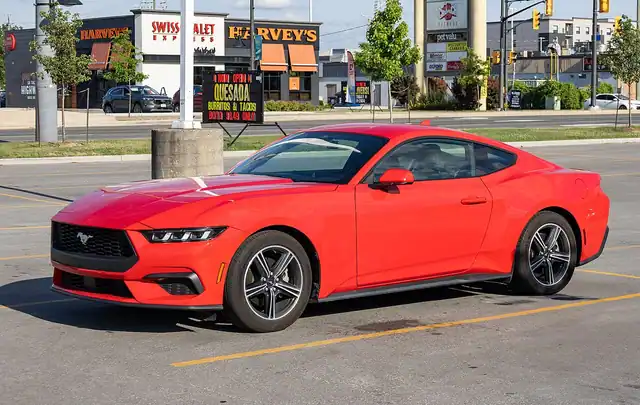
2023
2021
2022
2025–26
Ford Mustang reliability by year
Each year is complaints filed in that year’s first 3 years on the road, divided by however many of those years have passed. A model year younger than 3 years is too early to compare, so it is left out of the years named as having the fewest or the most complaints. Recalls are a separate count. The numbers are for the US-market Ford Mustang. How we count.
By model year
| Year | Per year on the road | Complaints | Recalls | Most-filed complaint | Avg. combined MPG |
|---|---|---|---|---|---|
| 2026 → Too early | 6 | 6 | 5 | Engine, Unknown or other, Powertrain | 18.2 |
| 2025 → Too early | 9 | 17 | 6 | Exterior lighting | 18.2 |
| 2024 → | 26 | 79 | 12 | Electrical system | 19.5 |
| 2023 → Fewest | 5 | 15 | 6 | Steering | 21.3 |
| 2022 → Fewest | 7 | 49 | 9 | Fuel system, gasoline | 21.4 |
| 2021 → Fewest | 7 | 55 | 6 | Fuel system, gasoline | 21.4 |
| 2020 → | 10 | 120 | 8 | Electrical system | 21.5 |
| 2019 → | 12 | 148 | 6 | Engine | 21.5 |
| 2018 → | 18 | 191 | 4 | Engine | 21.9 |
| 2017 → | 14 | 265 | 6 | Back-over prevention | 20.8 |
| 2016 → | 23 | 376 | 5 | Engine | 21.5 |
| 2015 → | 31 | 436 | 11 | Exterior lighting | 21.6 |
| 2014 → Most | 73 | 359 | 4 | Air bags | 20.8 |
| 2013 → | 18 | 271 | 6 | Air bags | 20.8 |
| 2012 → | 55 | 469 | 7 | Air bags | 21 |
Years with a → link have a full model-year page.
What owners file about
Generations
- Body styles
- Coupe, Convertible
- Oil
- 5W-20 (3.7L V6/5.0L GT); 5W-30 (4.0L V6, 2010); 5W-50 (Shelby GT500/Boss 302) · 6 qt capacity
- Tire size
- 225/60R17 (V6 base) to 255/40ZR19; Shelby GT500 255/45ZR18 front / 225/60R17 (V6 base) to 255/40ZR19; Shelby GT500 285/40ZR18 rear
Known issues for this generation
NHTSA investigation PE11-024 examined 364 reports of shift-quality problems in 2011-2012 Mustangs with the manual transmission, including higher shift effort in cold temperatures, a "clutch stay-out" delay above 4,000 rpm, and gradual loosening of clutch-plate bolts on some early-production cars; Ford addressed these with a lower-viscosity fluid (TSB 11-3-18), replacement clutch pedal parts (TSB 10-19-4), and a revised fastener implemented in production, and NHTSA closed the investigation without a recall, finding no indication of loss of motive power or unreasonable safety risk. Separately, NHTSA recall 16V-247 covered about 202,000 2011-2012 F-150 and 2012 Expedition, Mustang, and Lincoln Navigator vehicles for a 6R80 transmission output-speed-sensor lead-frame fault that could force an unintended downshift into first gear; Ford reprogrammed the powertrain control module and offered a free lead-frame replacement for up to 10 years/150,000 miles. This generation is also covered, together with the rest of the 2005-2014 Mustang range, by the Takata airbag inflator recalls — campaign 15S21 for the driver-side inflator and 19S01 for the passenger-side inflator — which replace the inflator to prevent a rupture in a crash. In an August 2024 supplement to 19S01, Ford escalated the passenger-side campaign to a DO NOT DRIVE advisory, stating that the age of these vehicles makes it increasingly possible that a part inside the airbag could rupture and send metal fragments into occupants during a crash, causing serious injury or death. It applies to any affected vehicle on which 19S01 has not been completed; check a VIN against NHTSA's recall lookup before driving one.
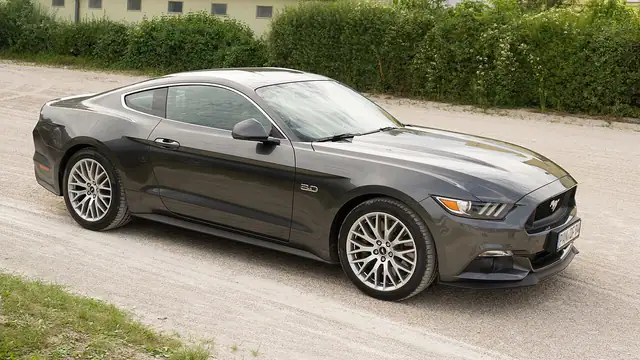

- Body styles
- Coupe, Convertible
- Oil
- 5W-20 (3.7L V6/5.0L GT); 5W-30 (2.3L EcoBoost); 5W-50 (GT350/GT350R/GT500) · 6 qt capacity
- Tire size
- 235/55R17 (EcoBoost/V6 base) to 305/30ZR20 (Shelby GT500) front / 235/55R17 (EcoBoost/V6 base) to 315/30ZR20 (Shelby GT500) rear
Known issues for this generation
NHTSA recall 22V-082 (Ford campaign 22S06) covers 2015-2017 Mustang vehicles built at Flat Rock Assembly Plant between February 2014 and October 2017 for damage to the luggage-compartment-lid wiring harness in the area of the right-side hinge, causing intermittent rear-view-camera operation, loss of satellite-radio reception, an inoperative trunk lamp, or a trunk release that fails to work; some early 2015-model cars also had an internal camera circuit-board conductivity issue contributing to the same symptoms. Separately, NHTSA recall 16V-779 (Ford campaign 16S40) covered 2015-2017 Shelby GT350 and GT350R models specifically for an engine oil cooler tube assembly with insufficiently crimped hoses that could separate and leak oil, risking engine damage and, in the presence of an ignition source, a fire.

- Body styles
- Coupe, Convertible
- Oil
- 5W-30 (2.3L EcoBoost and 5.0L V8 GT/Dark Horse) · 5.7 qt capacity
- Tire size
- 235/55R17 (EcoBoost, 2024) to 305/30R19 (Dark Horse Handling Package) front / 235/55R17 (EcoBoost, 2024) to 315/30R19 (Dark Horse Handling Package) rear
Known issues for this generation
NHTSA recall 24V-593 (Ford campaign 24S49) covers a narrow band of 4,595 2024 Mustang vehicles whose rear suspension knuckles may have a casting defect that causes them to fail, which can result in a loss of vehicle handling and steering control; Ford's remedy is a free inspection with replacement of the rear suspension knuckle as necessary. Separately, NHTSA recall 24V-220 (Ford campaign 24S19) covers 362 2024 Mustang vehicles equipped with the 2.3L engine for a low-pressure fuel supply line that may be damaged or cut, which can leak fuel. A fuel leak near an ignition source such as hot engine or exhaust components raises the risk of fire, and a loss of fuel may also stall the engine. Ford replaces the line free of charge.
Frequently asked questions
Which Ford Mustang years have fewer owner complaints?
Among years old enough to compare, the fewest complaints per year are 2023 at 5 (from 15 complaints), 2021 at 7 (from 55 complaints), and 2022 at 7 (from 49 complaints).
Which Ford Mustang year has the most owner complaints?
2014 has the most complaints per year, at 73 (359 complaints). On the 2014 Ford Mustang, 232 of 359 complaints name Air bags.
How do Ford Mustang owner complaints compare by year?
Newer Ford Mustang years have fewer owner complaints per year than the older ones. From 2018 on, complaints per year fall.
Which Ford Mustang years are too early to compare?
The Ford Mustang 2025 and 2026 model years are too early to compare: none has had 3 full years on the road yet.
Does the Ford Mustang have a towing capacity?
Ford's RV & Trailer Towing Guide rates the 2015-2023 (S550) Mustang at 1,000 lbs with an aftermarket hitch, and does not rate the GT350/GT350R to tow at all. Ford publishes no towing rating for the 2010-2014 or 2024-present Mustang.
What generation is my Ford Mustang?
2010-2014 is the facelifted S197 (5th generation), 2015-2023 is the S550 (6th generation, first with independent rear suspension), and 2024-present is the S650 (7th generation).