
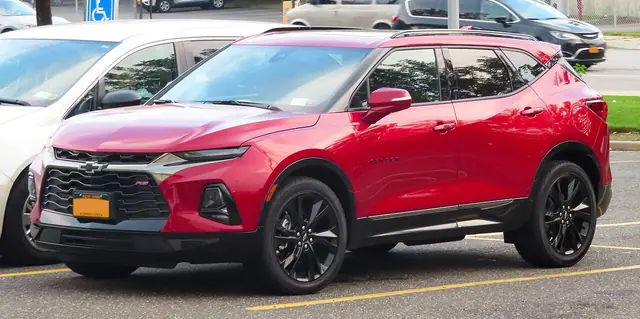
2025 Chevrolet Blazer reliability
The 2025 Chevrolet Blazer has 32 complaints with NHTSA after 2 years, or 16 per year. It is too early to rank against other Blazer years: a year is compared here only after 3 years on the road. NHTSA has 1 recall on file, including Latch.
32
16
1
2
The complaints owners file most often name Electrical system (8 of 32), then Forward collision avoidance (7) and Service brakes (4). Those filings include 2 that report a crash and 3 that report an injury.
The 2024 Blazer has 47 complaints, 16 per year, and the 2026 has 0 complaints, 0 per year.
The complaint rate is complaints filed in this year’s first 3 years on the road, divided by however many of those years have passed. Recalls are a separate count. The numbers are for the US-market 2025 Chevrolet Blazer. How we count. Data as of .
Recalls (1)
Complaints by component (32 total)
Show 7 more Show less
2
0
3
0
Complaints filed per year
Excerpts from recent NHTSA complaint filings
-
"The contact owns a 2025 Chevrolet Blazer. The contact stated that the vehicle experienced repeated phantom braking while driving at various speeds. The contact stated that the automatic emergency braking system…"
-
"What component or system failed or malfunctioned, and is it available for inspection upon request? On September 12, 2026, while parked at the top level of a parking garage, the vehicle unexpectedly began rolling forward…"
-
"I am concerned about a significant safety issue with my 2025 Chevrolet Blazer EV. On at least four separate occasions, the vehicle has unexpectedly applied extremely hard Rear Automatic Braking while I was backing up,…"
-
"The contact owns a 2025 Chevrolet Blazer. The contact stated that a GM inspector had inspected the vehicle due to phantom braking. The contact stated that while her husband was driving approximately 35 MPH, with her…"
-
"Rear bumper sagging issue. The internal clip fixing rear bumper is weak then the bumper is sagging. The rear bumper might be detached from the car during driving. There are many similar issues among the owners. [XXX]…"
NHTSA crash ratings
| Version | Overall | Front | Side | Rollover |
|---|---|---|---|---|
| 2025 Chevrolet Blazer EV SUV AWD | 5 stars | 5 stars | 5 stars | 4 stars |
| 2025 Chevrolet Blazer EV SUV FWD | Not rated | 5 stars | 5 stars | Not rated |
| 2025 Chevrolet Blazer EV SUV RWD | 5 stars | 5 stars | 5 stars | 5 stars |
| 2025 Chevrolet Blazer SUV AWD | 5 stars | 5 stars | 5 stars | 4 stars |
| 2025 Chevrolet Blazer SUV FWD | 5 stars | 5 stars | 5 stars | 4 stars |
Stars are how this vehicle did in NHTSA crash tests. They are a safety result, separate from the complaint record. Not rated means that test was not run for this version.
Fuel economy
| Trim | Engine | Transmission | Drive | City | Hwy | Combined | Annual fuel cost |
|---|---|---|---|---|---|---|---|
| Blazer all-wheel drive | 3.6L, 6-cyl | Automatic 9-speed | All-wheel drive | 18 | 26 | 21 MPG | $3100 |
| Blazer all-wheel drive | 2L, 4-cyl | Automatic 9-speed | All-wheel drive | 22 | 27 | 24 MPG | $2700 |
| Blazer EV all-wheel drive | — | Automatic (1-speed) | All-wheel drive | 102 | 87 | 95 MPG / 283 mi range | $800 |
| Blazer EV all-wheel drive SS | — | Automatic (1-speed) | All-wheel drive | 92 | 77 | 85 MPG / 303 mi range | $900 |
| Blazer EV front-wheel drive | — | Automatic (1-speed) | Front-wheel drive | 114 | 95 | 104 MPG / 312 mi range | $750 |
| Blazer EV front-wheel drive 22 inch tire | — | Automatic (1-speed) | Front-wheel drive | 103 | 86 | 95 MPG / 283 mi range | $800 |
| Blazer EV rear-wheel drive | — | Automatic (1-speed) | Rear-wheel drive | 106 | 85 | 95 MPG / 334 mi range | $800 |
| Blazer front-wheel drive | 2L, 4-cyl | Automatic 9-speed | Front-wheel drive | 22 | 29 | 25 MPG | $2600 |
| Blazer front-wheel drive | 3.6L, 6-cyl | Automatic 9-speed | Front-wheel drive | 19 | 26 | 22 MPG | $2950 |
Specs and fitment
Known issues for this generation
Recall 20V-668 covers certain 2019-2020 Chevrolet Blazer vehicles among other GM crossovers: the start/stop transmission accumulator end cap may have missing bolts, which can lead to a transmission fluid leak and possible loss of propulsion. Recall 23V-042 covers certain 2023 Blazer and Traverse vehicles: left-side half-shaft assemblies may be missing a retaining ring, which can allow the half shaft to disengage. Recall 23V-869 covers certain 2024 Blazer vehicles: door strikers may fracture and allow a door to open unexpectedly.
Compare
Frequently asked questions
Is the 2025 Chevrolet Blazer reliable?
The 2025 Chevrolet Blazer has 32 complaints with NHTSA after 2 years, or 16 per year. It is too early to rank against other Blazer years: a year is compared here only after 3 years on the road. NHTSA has 1 recall on file, including Latch.
What are common problems with a 2025 Chevrolet Blazer?
The complaints owners file most often name Electrical system (8 of 32), then Forward collision avoidance (7) and Service brakes (4). Those filings include 2 that report a crash and 3 that report an injury.
Is the 2025 Chevrolet Blazer more reliable than the years next to it?
The 2024 Blazer has 47 complaints, 16 per year, and the 2026 has 0 complaints, 0 per year.
Has the 2025 Chevrolet Blazer been recalled?
The 2025 Chevrolet Blazer has 1 recall on file with NHTSA. See the recalls table on this page for dates, components, and remedies.
How many complaints have owners filed about the 2025 Chevrolet Blazer?
Owners have filed 32 complaints about the 2025 Chevrolet Blazer with NHTSA.
What mpg does a 2025 Chevrolet Blazer get?
EPA-rated combined fuel economy for the 2025 Chevrolet Blazer is 62.9 MPG. See the fuel economy table on this page for city and highway figures by engine and transmission.
Is the modern Chevrolet Blazer a body-on-frame SUV?
No. The 2019+ Blazer is a unibody crossover distinct from the historical K5 Blazer.
What oil does a 2019+ Chevrolet Blazer take?
0W-20 for both the 2.0L turbo and 3.6L V6 common US powertrains. Confirm the filler-cap grade.
What does recall 20V-668 cover on early Blazers?
Certain 2019-2020 Blazer vehicles among other GM crossovers: the start/stop transmission accumulator end cap may have missing bolts, which can lead to a transmission fluid leak and possible loss of propulsion.