
2019 Toyota 4Runner reliability

Is it reliable?

The 2019 Toyota 4Runner has 65 complaints with NHTSA after 8 years, or 13 per year. That is the most complaints per year among the 13 4Runner years on this site. NHTSA has 4 recalls on file, including Fuel pump, Steering, and Labels.

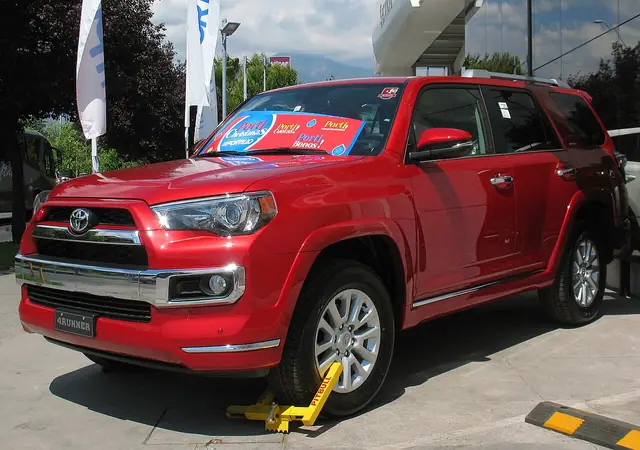
2016 Toyota 4Runner Limited
Photo by RL GNZLZ from Chile, resized from the original. Wikimedia Commons CC BY-SA 2.0
Complaints

65

Per year

13

Recalls

4

Years on the road

8

What owners report

The complaints owners file most often name Steering (10 of 65), then Electrical system (8) and Fuel and propulsion system (7). Those filings include 5 that report a crash, 1 that reports a fire, and 3 that report an injury.

Next to 2018 and 2020

The 2018 4Runner has 58 complaints, 11 per year, and the 2020 has 33 complaints, 7 per year. The 2019 has more complaints per year than the 2018. The 2019 has more complaints per year than the 2020.

The complaint rate is complaints filed in this year’s first 3 years on the road, divided by however many of those years have passed. Recalls are a separate count. The numbers are for the US-market 2019 Toyota 4Runner. How we count. Data as of .

Recalls (4)

Recall Fuel pump 2020-11-04 · NHTSA campaign 20V682000
Summary Toyota Motor Engineering & Manufacturing (Toyota) is recalling certain 2018-2019 4Runner, 2019-2020 Avalon, 2019 Corolla Hatchback, 2017-2019 Highlander, 2018-2020 Camry, 2020 Corolla, 2018-2019 Land Cruiser, 2017-2020 Tacoma, 2019-2020 RAV4, 2019-2020 Sequoia, 2017-2020 Sienna, 2019-2020 Tundra, 2018-2020 Lexus ES350, 2017 Lexus GS200t, 2017-2019 Lexus GS350, 2019 Lexus GS300, 2018-2020 Lexus LC500h, 2019-2020 Lexus LS500, 2018-2019 Lexus GX460, 2017 Lexus IS200t, 2019 Lexus IS300, 2019 Lexus IS350, 2018-2020 Lexus LC500, 2018 Lexus LS500, 2019 Lexus LS500h, 2018-2019 Lexus LX570, 2017 Lexus RC200t, 2019 Lexus RC300, RC350, 2017 and 2019-2020 Lexus RX350, 2018-2020 RX350L, 2019 Lexus UX200, 2018-2019 Lexus NX300 vehicles. The low-pressure fuel pump inside the fuel tank may fail.
Remedy Toyota will notify owners, and dealers will replace the fuel pump assembly with an improved one, free of charge. Owners of specific models were notified that remedy parts were available starting January 21, 2021. Owners of other models will be notified as remedy parts become available. Remedy parts should be available for all affected vehicles by late March 2021. Owners may contact Toyota customer service at 1-888-270-9371 or Lexus customer service at 1-800-255-3987. Note: This recall is an expansion of recall 20V-012. Toyota's number for this recall is 20TA02. Lexus' number for this recall is 20LA01.
Recall Steering 2019-09-20 · NHTSA campaign 19V670000
Summary Southeast Toyota Distributors, LLC (SET) is recalling certain 2018-2019 Toyota 4Runner vehicles. During installation, certain steering and suspension components may not have been properly tightened.
Remedy SET will notify owners, and dealers will inspect and re-tighten the steering and suspension fasteners as necessary, free of charge. The recall is expected to begin November 19, 2019. Owners may contact SET customer service at 1-866-405-4226. SET's number for this recall is SET19B.
Recall Labels 2019-03-27 · NHTSA campaign 19V244000
Summary Gulf States Toyota (GST) is recalling certain 2019 C-HR, 4Runner, Avalon, Avalon Hybrid, Camry, Camry Hybrid, Highlander, Land Cruiser, Prius, RAV4, Sequoia, Tacoma, Sienna, Tundra and Yaris vehicles. The text on the load capacity label may become illegible. As such, these vehicles fail to comply with the requirements of Federal Motor Vehicle Safety Standard (FMVSS) number 110, "Tire Selection and Rims."
Remedy GST will notify owners, and dealers will provide corrected load carrying capacity modification labels, free of charge. The recall began May 24, 2019. Owners may contact GST customer service at 1-800-444-1074. GST's number for this recall is 19R1.
Recall Labels 2018-10-25 · NHTSA campaign 18V753000
Summary Southeast Toyota Distributors, LLC (SET) is recalling certain 2017-2019 Toyota 4Runner vehicles that SET modified to be equipped with a TRD wheel package. The Gross Vehicle Weight Rating (GVWR) on the certification label may be incorrect, possibly resulting in the vehicle being overloaded. As such, these vehicles fail to comply with the requirements of Federal Motor Vehicle Safety Standard (FMVSS) number 110, "Tire Selection and Rims."
Remedy SET will notify owners and mail them corrected certification labels, free of charge. The recall began November 28, 2018. Owners may contact SET customer service at 1-866-405-4226. SET's number for this recall is SET18A.

Complaints by component (65 total)

Steering
10
Electrical system
8
Fuel and propulsion system
7
Suspension
7
Engine
6
Fuel system, gasoline
6
Air bags
5
Service brakes
5
Powertrain
4
Structure
3
Wheels
3
Seat belts
2
Visibility
2
Visibility and wipers
2
Back-over prevention
1
Forward collision avoidance
1
Latches, locks, and linkages
1
Tires
1
Show 10 more Show less
Crash-flagged

5

Fire-flagged

1

Injury reports

3

Death reports

0

Complaints filed per year

520191320202020215202252023520248202542026
Excerpts from recent NHTSA complaint filings
  • "Thankfully the piece of my shock coil spring fell off in my driveway on Aug 23rd 2026. I am being told I should not drive my car now as the entire coil spring can come off and cause me to crash. They have a 2018 trd pro…"
    Suspension · filed 2026-09-16
  • "I have experienced a persistent steering and suspension-related issue with my 2019 Toyota 4Runner since early ownership, beginning at approximately 6,800 miles. The vehicle repeatedly pulls/drifts to the right at…"
    Steering, Suspension, Wheels · filed 2026-05-06
  • "My 2019 Toyota 4Runner has experienced an ongoing steering and suspension issue since early in its life. The vehicle required an alignment at approximately 6,800 miles and has required repeated alignments since. At…"
    Steering, Suspension · filed 2026-04-28
  • "Vehicle Back-up camera works intermittantly, sometimes working when placed in reverse, other times showing a black screen when placed in reverse. Has not been a consistent enough problem for dealer…"
    Back-over prevention · filed 2026-03-25
  • "My 2019 Toyota 4Runner is experiencing a faulty backup camera, the display shows a frozen or blank image when reversing, increasing the risk of a crash. The current Toyota backup camera recall includes 2020 and later…"
    Unknown or other · filed 2025-11-19

NHTSA crash ratings

Version Overall Front Side Rollover
2019 Toyota 4Runner SUV 2WD 4 stars 4 stars 5 stars 3 stars
2019 Toyota 4Runner SUV AWD 4 stars 4 stars 5 stars 3 stars

Stars are how this vehicle did in NHTSA crash tests. They are a safety result, separate from the complaint record. Not rated means that test was not run for this version.

Fuel economy

Trim Engine Transmission Drive City Hwy Combined Annual fuel cost
4Runner two-wheel drive 4L, 6-cyl Automatic (5-speed) Rear-wheel drive 17 21 18 MPG $3600
4Runner four-wheel drive 4L, 6-cyl Automatic (5-speed) Part-time four-wheel drive 17 20 18 MPG $3600
4Runner four-wheel drive 4L, 6-cyl Automatic (5-speed) All-wheel drive 17 20 18 MPG $3600

Specs and fitment

5th generation (N280), 2010–2024
Body styles SUV
Oil 0W-20 , 6.6 qt capacity
Tire size P265/70R17 113S (SR5/TRD), P265/60R18 (Limited), P245/60R20 107H (TRD Pro), 245/70R17 (select trims)
Towing capacity 5,000 lbs

Known issues for this generation

NHTSA campaign 19V005 covers certain Toyota 4Runner vehicles with passenger frontal air bag inflators that may explode after long-term exposure to high humidity and temperature cycling, including 2014-2016 4Runner models registered in NHTSA Zone A states and territories, 2011-2016 4Runner models in Zone B, and 2010-2016 4Runner models in Zone C. Depending on the vehicle, dealers replace the front passenger air bag inflator or the air bag assembly, free of charge. NHTSA campaign 20V682 covers certain 2018-2019 Toyota 4Runner vehicles among a larger Toyota and Lexus population: the low-pressure fuel pump inside the fuel tank may fail. If the pump fails, the engine can stall while driving, increasing the risk of a crash. Dealers replace the fuel pump assembly with an improved one, free of charge. That campaign expands NHTSA recall 20V-012.

Compare

Frequently asked questions

Is the 2019 Toyota 4Runner reliable?

The 2019 Toyota 4Runner has 65 complaints with NHTSA after 8 years, or 13 per year. That is the most complaints per year among the 13 4Runner years on this site. NHTSA has 4 recalls on file, including Fuel pump, Steering, and Labels.

What are common problems with a 2019 Toyota 4Runner?

The complaints owners file most often name Steering (10 of 65), then Electrical system (8) and Fuel and propulsion system (7). Those filings include 5 that report a crash, 1 that reports a fire, and 3 that report an injury.

Is the 2019 Toyota 4Runner more reliable than the years next to it?

The 2018 4Runner has 58 complaints, 11 per year, and the 2020 has 33 complaints, 7 per year. The 2019 has more complaints per year than the 2018. The 2019 has more complaints per year than the 2020.

Has the 2019 Toyota 4Runner been recalled?

The 2019 Toyota 4Runner has 4 recalls on file with NHTSA. See the recalls table on this page for dates, components, and remedies.

How many complaints have owners filed about the 2019 Toyota 4Runner?

Owners have filed 65 complaints about the 2019 Toyota 4Runner with NHTSA.

What mpg does a 2019 Toyota 4Runner get?

EPA-rated combined fuel economy for the 2019 Toyota 4Runner is 18 MPG. See the fuel economy table on this page for city and highway figures by engine and transmission.

What generation is the 2020 Toyota 4Runner?

5th generation (N280), model years 2010-2024 in the US.

What oil does a Toyota 4Runner take?

Fifth-generation US 4.0L V6 models use 0W-20 (about 6.6 qt with filter). 2025+ sixth-generation 2.4L i-FORCE models use 0W-20 (about 5.9 qt with filter).

How much can a Toyota 4Runner tow?

The fifth-generation 4.0L V6 is rated for 5,000 lb (trailer plus cargo). The 2025+ sixth generation lists up to 6,000 lb when properly equipped; i-FORCE trims are limited to 5,000 lb with a dead-weight hitch.